
What Is a Contact Center? Types, Software & KPIs for 2025
Article Date: 2025-09-15T10:30:00+00:00
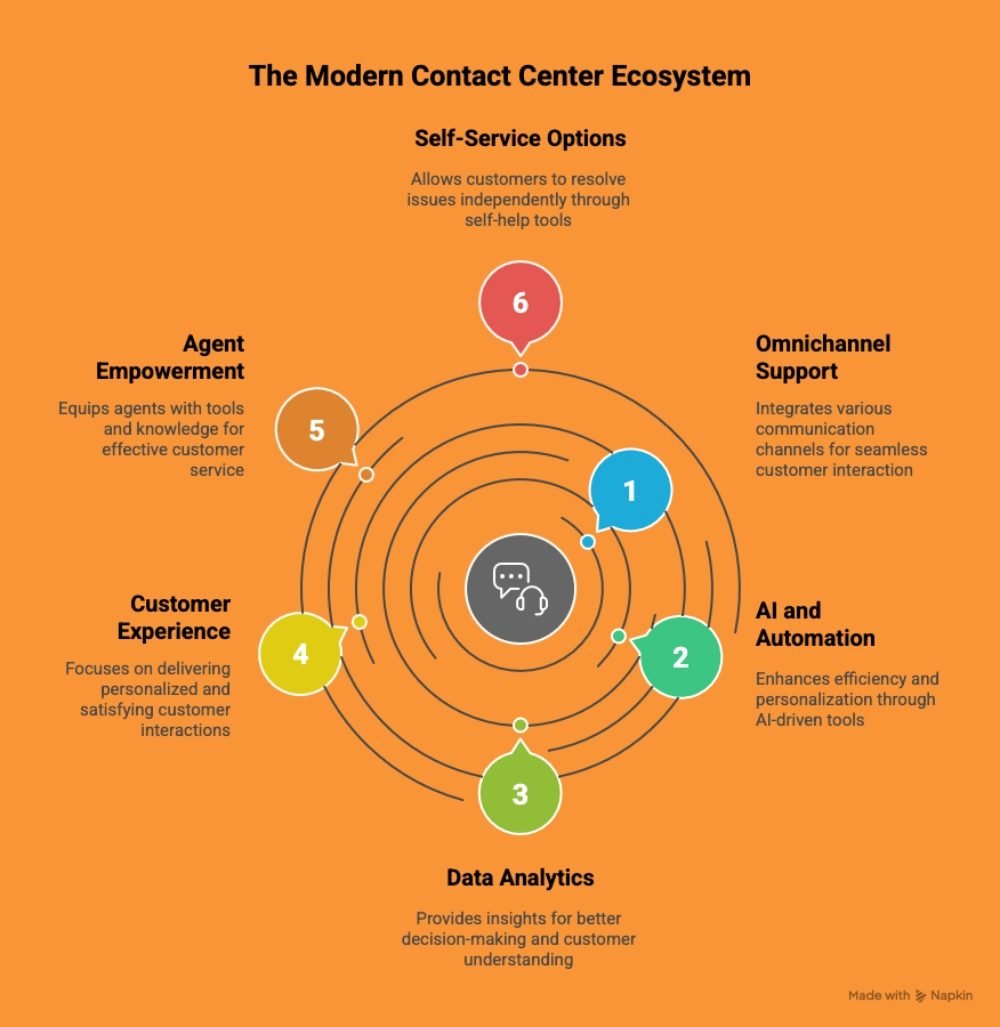
Summary
The article breaks down what a contact centre is in 2025: an omnichannel hub that unifies voice, chat, messaging, email and video, powered by AI, analytics and knowledge systems while keeping human agents central for empathy and complex issues. It contrasts call centres (voice-only) with modern contact centres, outlines platform types (hardware, cloud, hosted, virtual), lists core technologies and explains the KPI shift from handle time to first contact resolution, effort scores and journey quality.
Key Points
- Contact centres are omnichannel hubs that maintain context across voice, chat, SMS, social and video.
- Call centre vs contact centre: voice-only operations versus unified, personalised experiences.
- AI and generative models act as copilots—automating routine work while surfacing context and suggestions for agents.
- KPIs are evolving: focus moves from handle time to first contact resolution (FCR), effort score and journey quality.
- Platform choices matter: on-premises for control/compliance; cloud for scale and flexibility; hosted/outsourced for speed; virtual for remote work.
- Core tech stack includes ACD/CTI, NLU IVR, generative/conversational AI, CDPs/knowledge bases, analytics and workflow automation.
- Shift from reactive to proactive service driven by real-time analytics and agent-assist tools.
- Major challenges: 24/7 operations, staffing and scheduling, system uptime, security, and balancing automation with human empathy.
- Contact centres are transitioning from cost centres to growth engines tied to retention and lifetime value.
Content Summary
The guide explains how modern contact centres deliver faster, easier, more human support by combining omnichannel routing with AI-enhanced tools. It highlights that customers expect seamless, personalised help on any channel and that a single poor experience can drive churn. Examples and research (including a 2024 Forbes stat and a 2025 Verizon case) illustrate how AI assistants and agent copilots improve resolution rates while customers still value transparency and human-led interactions.
It also outlines operational models (hardware, cloud, hosted, virtual), the technologies shaping the centre (NLU, generative AI, CDPs, WFM, analytics) and the practical trade-offs organisations must weigh when choosing a platform—security and control versus scalability and speed-to-market.
Author’s take
Punchy and practical: if you run customer ops, this is the nitty-gritty you need. The piece cuts through hype—AI helps, but humans still win the trust game. Treat your contact centre as a strategic asset, not a cost line.
Why should I read this?
Short answer: because customers now expect instant, personal help wherever they are. This article saves you time by laying out what a modern contact centre actually looks like, what tech to care about, and which KPIs prove it’s working. If you need a quick playbook to brief leadership or pick a platform, read it.
Context and Relevance
In 2025 the contact centre sits at the heart of customer experience strategy. Ongoing trends—rising expectations for omnichannel continuity, growth in messaging channels, wider adoption of generative AI, and a KPI shift toward outcome-focused metrics—make the guidance in this article highly applicable for CX leaders, ops managers and technology buyers. Organisations that adopt AI-assisted workflows while preserving human empathy will be best placed to reduce churn and increase lifetime value.
